10-06-2012

Excursion into Ferghana Valley


The reason to go was the invitation for the
wedding party of Zyo, a colleague of Robert. We were expected at 14:00 at Manangan, not knowing what to expect. So, together with Yasur, a former colleague with car, and a good driver as well, we set out on Friday 7:30 for what in fact was a three day holiday and excursion into this part of the country.
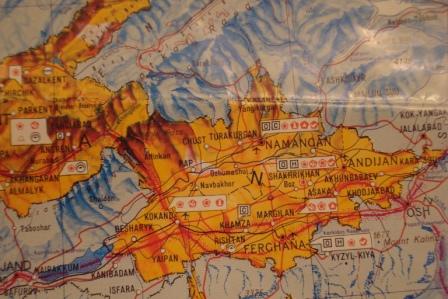
Fergana Valley is almost as large as the Netherlands, measuring 200 kms in length en 150kms width.  But to get there is a 5 hours drive, crossing the mountain range via a high pass, a few tunnels and a proper border control etc. On the map to the right, Tashkent would be at the location of the last n of mountain (4 lines up).


The wedding was a surprise. We happened to be invited for only the first part of a three day event, which we hadn't understood. Friday afternoon was for the bridegrooms’ friends and relatives. The VIPs ( = we and a German guy who had flown in the day before and came late) were led into a room at a table full of fruit and food; the Uzbekistan friends in another room, having the same good treatment on the floor, which is the custom here. And different foods being served the whole afternoon!


Zyo, his father and the VIP guests -->


As yAs you
 can imagine, I was an exception, as all the women were (naturally !?) in the kitchen, to do all the work. When we left and I wanted to say goodbye to  Zyo’s mum, feeling that at least I should honor  her for being his mum and the hostess and the lady in charge, it became a special event and I wasn’t allowed  to leave before I got a special present, a few meters of the locally made silk enough for a dress!


We left for our hotel. Which unfortunately was next to the garden/ bar where the start of the UEFA cup was being broadcasted on a large screen.  We experienced all the goals and the excitement about them,  especially  the Russia- Czech match! We thought we could go to sleep after the second match but a third one was on, bad luck.  


The next morning was another part of the wedding ceremony: at 05:00 plov (pilav) was being served for the men (about a thousand!). Robert and Yasur went there.

At 07:30 we left for Margilan, another 2,5 hours drive right through the fertile loess valley, which looks like the latest Dutch polders, flat, with a lot of canals (here for irrigation rather than drainage) and Poplars, Mulberry trees (cut back like our willowtrees, to feed the silkworm), wheat and cotton and vegetables. 


In Margilan we visted a modest silk factory and were shown the whole process from cooking the cocoons into silk threads, to colouring, weaving, knitting carpets (1 cm a day, by two girls from 8am -5 pm).

Afterwards, we were quite unexpectedly invited by family of Yasur, to the one-week-after-the wedding-party. It is custom that exactly a week after a wedding, the extended family comes to greet the new bride, who will bow three times for each guest. So we were there, being very warmly welcomed, with more food, more plov! And a very beautiful bride!

From there we went to Rishtan, another hours’ drive though mainly agricultural land, to a ceramics making family. Indeed they were there, and showed us how they make mainly teacups. The sun is so hot that they don’t need an oven to dry the cups! The 8 women doing the painting in a cosy and shady place.

We slept in Kokand, another old Silk Road city, where the mosks, the palace of the Khan and his 40 concubines, and many Madrassa’s have been demolished in 1919 by the soviets. We went to a very nice B&B, of a family famous for its woodwork. The lady in charge made us very welcome, prepared a lovely meal and we relaxed in her yard within the compound.


Next morning, Sunday, we visited the restored Jumi mosk, with pillars of red hardwood form India, the restored Kahns palace and a beautiful mausoleum, all very worthwhile.


Around 10:30 we set out for our return trip to Tashkent, arriving warm and dusty at round 15:00.  


Beautiful sights on the way!


04-06-2012

Working on my book

I am working daily now on my book " The Whole Earth" (in Dutch it is called: Heel de Aarde!)
It is about the opportunities we have to feed the whole world, by restoring agro-ecosystems into coherent, resilient systems. This is only possible by restoring natural cycles on various scales, at farm level, regional, riversystems, worldwide.
I found a very good website with examples, which I  recommend to people interested in this stuff: http://www.managingwholes.com/.  

03-06-2012

A hot and hazardous week

A hot and hazardous week
Last week, life seemed to be under severe pressure, everywhere. While it is hot outside, daily temperatures above 30 degrees, roses flower and wilt within a week’s  time, red cherries on the trees in the street, summerflowers everywhere
….many things were turned upside down:
 
1. A Worldbank representative was here for a supervision mission of Roberts project. Hectic!   An error in the original contract (no money budgeted for the topographical survey, an essential part of the project) made for aggressive discussions, diplomatic maneuverings, finding and discussing alternatives, Robert not sleeping very well, and – in the end- an undecided conclusion on May 31st.

The consultancy company (Roberts employer) now has to find additional money in the contract (the suggestion is to reduce international input) and take some additional financial risks and come up with a solution on June 7th at the latest. Presently they are not willing to agree with this solution. If they don’t, the government here might decide to terminate the contract, (one month notice) and we would find ourselves home again by half July.  Que sera? But then again, the soup is never eaten as hot as it is served 

2. Our daughter Meike decided to quit her study psychology in the Netherlands. After all the efforts she had put in, it wasn’t what she wanted or had hoped for. What a disappointment for her it was! And a difficult decision to take. She is now reorienting herself and we hope she will be a happier and more satisfied person in the future.

Meanwhile life here just continues and we went to an amazingly good concert in the Roman Catholic Polish Church (picture left)  


3.  Of our good friends a couple is going through difficult times since about 2 years, which turned into a definite divorce announcement by May 30st. It is painful and sad, and we are in thought and emails very often with them.

 So our weekend now is suddenly very quiet and relaxed.

Picture right and left are of the Government park around the statue of the weeping mother (only open to the public on Sundays) and Government buildings strewn in it


So, we had some recent Uzbek friends for dinner on Saturday evening.

And this Sunday morning we took a long walk through the parks , enjoying the summer smell of roses, mowed grass and the wish-wush sound of fountains – which are turned on everywhere, for the better enjoyment of life of ‘the population’ .

To our surprise we recognised some beloved real tropical trees here,  next to West European species.

18-05-2012

Our Bukhara Experience

Bukhara is one of the three most important cities along the Silkroad, in this country. It lies in between Samarkand (which is 5 hours by car form Tashkent) and Khiva, 3 hours flight into the desert, nearer to the Aral sea. And it has always had a crucuial role, due to its many sweet waterponds (important in the middel of the desert) and its strategic location.
Since we‘ ve been in Samarkand we know a lot about the history of this country and of all the peoples moving in, conquering and deserting it . Our main source is the marvelous book I happened to buy just before leaving (at amazon.com):  “ Uzbekistan, the golden road to Samarkand”


Once upon a time there was a Sogdian empire of Persion origin from about 700 BC till 700 AD. They already had irrigation, fountains in the cities and a sewage system! Which we didn’t even have in Amsterdam in the 16th century yet!  There was a highly developed civilization with contact in China, India, Turkey; witnessed by remains of frescoes. The copy on the right is a bit too colourful, but otherwise a just representation. All sorts of religions existed together, the Zoroastrians most prominently.

In 329 BC  Alexander the Great remarked, when seeing its capital Samarkand, after his famous crossing of the river Oxus (now the Syr Daria, the river which is the southern border to Afghanistan and Turkmenistan) that the city was even more beautiful than the stories told. Samarkand in that time was known as Marakand, and its remains, now called Afrosiab, lay a bit outside of the present town. So we explored the eroded claybrick ruins of the old city and the city walls, which originally were 15 kms long.  
Notice the shape- it looks very much like the now restored citadelwalls of Bukhara, further down!

Around 640 AD the Islam was brought here (to Transoxiana as they called it) by no one less than the cousin of Mohammed himself. It was a rough time! Either you turned Moslim or died, or at best became a slave. The city of Bukhara held out the longest of all but had to succumb in 709.

After the Arab empire weakened, a true Golden Age followed under the Samanyid rulers from 900- 1100, attracting the finest intellectuals of the time. The irrigation networks were expanded, the population of Bukhara grew to 300.000, more than in soviet times, and Bukhara had the biggest library of the Islamic world.


Below: the now restored wall of the Citadel of Bukhara, the city within a city where the Emir resided. Bukhara is now a Unesco heritage. 


 All this to be disturbed by invasions, first by the Turkoman around 1100, then in 1220 by Dhengis Khan with his fierce Mongol fighting force.


The once beautiful city of Bukhara was razed to a level plain. Everything was demolished, apart from the beautiful Kalon(Grand tower, to the right, detail directly below),  the mausoleum of Ismael Samani -at that time hidden in desert below,  and the Magok–I-attari Mosk.


Each of these buildings  have a remarkable architecture, and decorations, still without colours, but made by a variety of brick patterns.
Interesting to discover are the very old culture symbols like the circles ( the Zoroastrian sun) Swastika, th flower of life, and the yin-yang symbol.


Around 1500 Abdullah Khan reunited the Uzbek clans and prepared the gound for Bukhara’s 2d golden age.  Craftsmen abducted from Herat (Afghanistan) fuelled a flowering of decorative arts and the city began to take its present shape.

To the left a Caravanserai: notice the entrance being high enough for laden camels to pass through!


To the right is another mausoleum, mainly beautiful from the outside. The picture at the bottom shows the cupola of one of the Mosks from the inside.

Around 1600 Bukhara boasted 150 madrassahs(schools) and 200 district mosks. The picture below shows the inside court of one of the Madrassahs. I think you could compare its role and impresiiveness at that time to a university like Oxford and Cambridge, or a big monastery. Each student had his own cell.

Between 1600 and 1800 there was a strong decline, as overland routes withered since the Dutch, British and  Portugese were operating a succesfull sailing route to the spice islands and China.
Actualy the soviets did improve a lot for the country, if only to restore the same rights for men and women.

12-05-2012

Birdwatching tour in Uzbekistan 6-11 May

As May is the best season for bird watching,  Jelleke chartered a tour operator, experienced in  bird watching tours, to guide us around Bukhara and Samarkand and along the road to Tashkent to the various spots where we would be able to see the various birds that are passing or breeding in this country. Towards this purpose Rob took up a week holiday, even though this will be substracted from the vacation in the Netherlands this summer.
We visited different areas ( habitats or ecosystems): the Bukhara wetlands, the Kyzyl Kum desert, the Kattakurgan reservoir, the Tachtakaracha Pass (mountains) and the Zerafshan State Reserve (Forest).
Our guide was Katya Filatova, a young Uzbek biologist with a specialization in ecology. Including the ubiquitous common mynahs, magpies and sparrows our birds list included some 60 different species by the time we got home.
The images that follow are taken from internet as Jelleke’s camera (Sony Cybershot from the black market in Ethiopia) is not able to provide the required detail.
.
Most common here:
1.Common Mynah,the same one that nests under the roof next to our bedroom window, making an lot of noise, usually found in housing areas.
2.European Roller, sitting on electriciy lines everywhere: a beautiful blue flash when seen flying away. We even found them sitting near their nest, a hole in a clay escarpment.


Most unexpected 1:
Rose Coloured Starling (spreeuw in Dutch) ,


Most unexpected 2.
White Winged Woodpecker,
A beautiful sight when flying: all white wings!


 Most flashy 1: European Bee Eater,


Most flashy 2: 
Red crested Mallard, in the wetlands,
see next picture.
Most elusive 1: Turkestan Ground Jay (not seen). Living in the desert, feeding on insects.


Most elusive 2: Nightingale.
But we heard many, singing the stars out of the sky in the forest reserve.